Investments
Seven tickers on a 30-minute clock, five deeds that pay rent forever — and the fine print on both.
For beginners
Three ways to make money without a cooldown grind: a live stock market that ticks every 30 minutes (shared across every server), real estate that pays rent every 24 hours, and the bank's fixed deposits when you want a guaranteed number. Stocks are the only one that can lose.
Tip: Stock prices drift slightly DOWNWARD by design between events — buy-and-forget loses slowly. Stocks here are for trading the news, not passive holding.
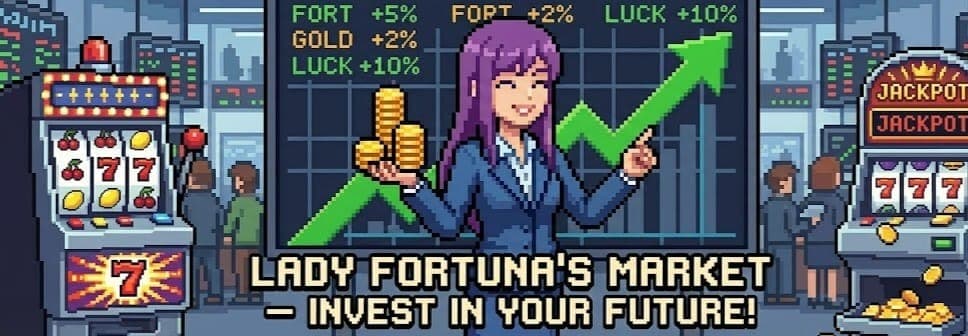
The stock market: the board
One global market, seven listings, ticking every 30 minutes. Volatility is the personality of each stock — it scales both the size of every move and how often events hit it. Liquidity decides how much your own order moves the price against you.
| Symbol | Company | Base price | Volatility | Risk label |
|---|---|---|---|---|
| FRTN | Fortuna Holdings | 1,500 | 3 | Stable |
| VEGA | Vega Resorts Intl. | 600 | 5 | Stable |
| ACES | Aces High Gaming | 250 | 8 | Moderate |
| LUCK | Lady Luck Lottery Co. | 120 | 14 | High |
| CHIP | ChipCoin | 60 | 20 | High |
| JACK | Jackpot Labs | 40 | 24 | High |
| BUST | BustBet Inc. | 15 | 30 | Extreme |
When a stock dies, a reserve company IPOs to replace it — RollDice Corp, House Edge Capital, and Wildcard Ventures are waiting in the wings.
How prices move (and why they sink)
Every tick, each stock takes a baseline drift drawn between −3% and +0.5%, scaled up by volatility — the average tick is negative. What makes money is the event engine: each tick also rolls roughly a 30–85% chance (rising with volatility) of an event, from minor dips and gains to multi-tick SLUMPS, RALLIES of 8–20%, CRASHES of 15–35%, and rare BOOMS of 20–45%.
The big events are telegraphed: !stock news shows 🔮 RUMOR forecasts one tick ahead — and forecasts come true 65% of the time. That 65/35 split is the entire game: buying a rumored BOOM is a positive-EV bet, and it still fakes out one time in three.
There are no flat trade fees — the cost is slippage. Your order impacts the fill price by up to 40% depending on size versus the stock's liquidity: trading 500 shares of thin BUST moves the market against you brutally; the same order in FRTN barely ripples. Trade deep stocks in size, thin stocks in slivers.
Delisting: the death spiral
A stock trading below 3% of its base price starts a delist watch. Four consecutive ticks down there flags it DELISTING — sell-only from that moment. Eight ticks and it's DELISTED: holders are auto-paid the final price (often pennies), and a reserve stock IPOs in its place.
The DELISTING badge is therefore a countdown measured in hours, not days: four more bad ticks is two hours. Decide immediately — average down never, sell or ride to the floor.
Trading commands
!stock is the market board; !stock buy <symbol> <qty> and !stock sell <symbol> <qty> execute at slippage-adjusted prices; !stock news is the rumor mill; !my-stocks and !stock portfolio show every position with live profit and loss. Your average buy price is cost-averaged across purchases, so P&L is honest about what you actually paid.
Real estate: the rent table
Five regular properties, each ownable once per player, paying rent on a 24-hour cycle collected via !collect-rent (uncollected rent waits for you — the cycle just needs 24h between claims). Sell-back is 75% of current value.
Prices are dynamic: every copy sold anywhere in the world raises that property's price 5%. Early buyers lock in the floor and enjoy the appreciation on sell-back.
| Property | Base price | Rent / 24h | Days to break even |
|---|---|---|---|
| Shack | 1,800,000 | 12,000 | 150 |
| Apartment | 5,400,000 | 36,000 | 150 |
| House | 16,000,000 | 108,000 | ~148 |
| Mansion | 47,000,000 | 312,000 | ~151 |
| Private Island | 126,000,000 | 840,000 | 150 |
Zoo properties (Mini 1.8M / City 15M / World 75M) are the exception to the flat-rent rule — their income comes from the animals you house, and a full zoo dramatically out-earns any regular deed. See Hunting & Animals.
The guaranteed shelf: FDs
When stocks feel like the casino with extra steps, the bank pays a locked 10% APR on fixed deposits of any size and duration — !bank fd <amount> <days>, prorated daily, no way to lose except waiting. The full mechanics (and why the 8% recurring deposit is a trap) live in the Bank & Credit docs.
Getting better at investing
Trade the news cycle, not the chart. The only durable edge is the 65% forecast: check !stock news every tick or two, buy rumored rallies/booms, exit after resolution. Holding through quiet periods just donates the negative drift.
Size by liquidity, not conviction. Slippage charges you both ways — a round trip in a thin stock can eat 20%+ before the price moves at all. FRTN and VEGA absorb real size; BUST and JACK are for small, violent bets on telegraphed events.
The volatile end is a lottery with better odds: BUST at volatility 30 catches the biggest booms AND sits closest to the delist floor. Never put rent money there — but a rumored BOOM on a 15-coin stock is the best risk/reward ticket on the board.
Order of operations for idle cash: property first (permanent, robbery-proof, ~0.67% per day forever), FDs for money with a known date, stocks only with money you can watch. Rent plus a full zoo is the closest thing Fortuna has to financial independence.
Commands in this module
Pro tips
- Forecasts hit 65% of the time — a rumored CRASH is a sell signal even if you like the stock. Re-enter after the fakeout resolves.
- Buy properties early: +5% per copy sold globally means popular servers inflate deeds fast, and your 75% sell-back is computed on the NEW price.
- All five regular properties pay back in ~150 days — buy in whatever order you can afford; there's no wrong pick, only idle cash.
- DELISTING = sell-only and roughly a 2–4 hour fuse. If you're not deliberately gambling on the bounce that can't come, take the pennies.
- Check !my-stocks before claiming victory — slippage means your real cost basis is higher than the chart price you remember buying at.